The Myth of the Congregational Range
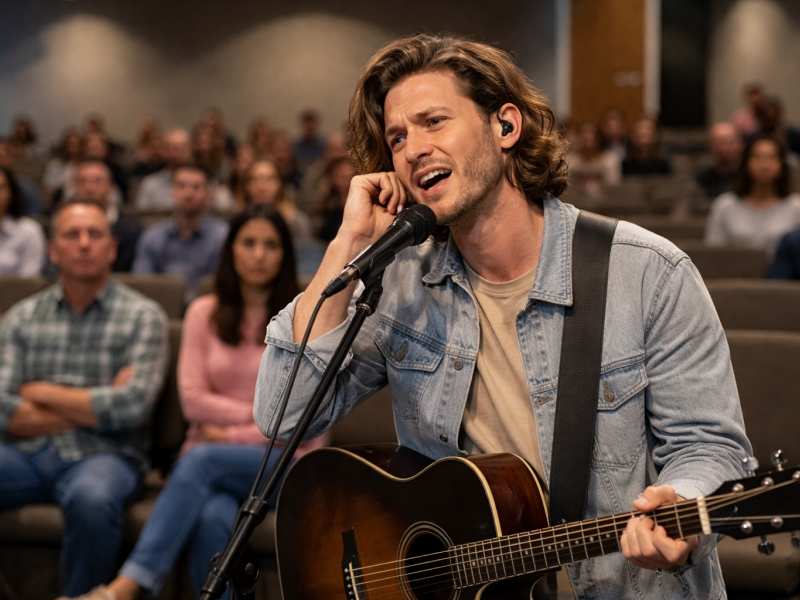
For years, I was one of those worship pastors who taught the rule.
If you've been in worship leading circles for any length of time, you've probably heard it: the "congregational range" runs from roughly an A below middle C up to a D or E above it. Pitch your songs within that window, and your congregation will sing. Pitch outside it, and you'll lose them.
I've taught that in churches across several countries. I believed it. I thought I was doing people a favour.
I've changed my mind.
What actually makes a congregation sing
Here's what I've noticed, consistently, over years of leading worship and watching others do it: people follow confidence. Not range. Not pitch. Confidence.
When a vocalist is singing in a key that genuinely suits their voice - when there's no strain, no reaching, no barely-surviving-the-bridge energy - the room responds. Congregation members aren't sitting there calculating whether the root note is accessible. They're reading the singer. They're catching the energy. They're deciding, in about three seconds, whether this person is leading or just performing, and whether it's worth joining in.
Strong, confident leadership is the single biggest driver of congregational participation. And that confidence is hardest to fake when you're singing outside your comfortable range.
The rule never accounted for real voices
The congregational range model was built, broadly, around a particular voice type. Soprano-leaning. High and bright. It worked well enough when that was the dominant sound shaping popular music and, by extension, worship music.
But listen to what's happening in pop culture over the last decade or so. The voices getting the most traction are richer, warmer, and lower. Alto and contralto tones. Chest-voice power. The kind of sound that doesn't reach up to an E5 and wasn't designed to.
My worship team in Jersey reflects that shift beautifully. I've been consistently blessed with singers who have incredible voices - rich, full, warm - and who would be doing themselves a disservice trying to contort those voices into a mould that was never built for them. Watching them lead in a key that actually suits them is a completely different experience from watching them manage.
And here's the thing: humanity doesn't come in neat templates. Every person who stands behind a microphone has a unique vocal instrument. There is no golden-bullet congregational range, because there is no standard human voice.
So what do we do instead?
Pick the key that suits the singer.
That's the new rule. Or rather, that's the principle. Because there's still some nuance worth holding onto.
Context matters. If you're leading in a small acoustic room with no PA, with people gathered closely around you, I'd pitch things a tone or two lower than I would on a large stage. Not because the congregation can't reach the notes - but because the energy of that room calls for something more intimate, more effortless-sounding. Conversely, on a large platform with a big sound system and a few hundred people in front of you, there's typically more energy available. You can pitch higher and the room will meet you there.
The question isn't "will they be able to sing it?" The question is "will this performance make them want to?"
Lead from your strengths
Worship leading isn't a vocal endurance test. It's an act of invitation. And the best invitations come from people who are clearly comfortable, clearly convinced, and clearly not thinking about whether they can hit the next note.
Find your range. Lead from there. The congregation will follow.